
It’s scary, isn’t it?
Having to tell a truth to someone who may not want to hear it.
Whether you have to tell a friend they’ve been betrayed, inform a client that their ideas suck, or write a blog post to burst your reader’s bubble, hard truths can feel almost as painful to deliver as they are to receive.
Because just the thought of hurting someone is scary. You don’t want that.
And you don’t know how they’ll react. They might think you’re a jerk and cut all ties with you. You don’t want that either.
So sometimes you obfuscate the truth to spare them the pain of hearing it. Sometimes you even keep it to yourself or tell a white lie.
Well, I have to tell you something, and you may not like to hear it. But if you struggle with the art of being frank, you need to hear this. It will make you a better person, a better communicator and a better blogger.
So here it is …
You’re a coward.
If you can’t be brutally honest with people, especially when you know it’s in their best interest, you’re a coward.
Why You Can’t Be a Coward When It Comes to Hard Truths
You’re not doing anyone a favor by withholding a truth from them, even if it’s difficult for them to hear.
The only person you’re protecting is yourself. Because you’re afraid of the consequences to you.
But it’s not about you.
Being honest is about making sure your audience has the information they need to make good decisions. That includes information they may not like.
You may convince yourself it’s “nicer” to hide or obfuscate things that are difficult for them to hear, but it’s not.
Ignorance doesn’t lead to bliss, it leads to bad decision-making. There’s nothing “nice” about that.
And as a blogger trying to help your readers, honesty is that much more important.
Because readers rely on your expertise and your candor. They rely on you to set them straight when they’re headed the wrong way. They rely on you to guide them in the right direction.
You may fear you’ll lose readers when you tell them a hard truth, but withholding it is far riskier. Because it will hurt your credibility in the long run.
When you’re honest at all times, whether in your writing or in your personal life, people will know what to expect from you. And when they need the truth, you’re the one they will come to.
Yes, you may lose some readers along the way, but you’ll gain the trust and respect of so many more.
The Big Mistake People Make While Being Brutally Honest
Brutal honesty is not about being cruel, rude, shocking, or harsh. That’s not brutal honesty. It’s just brutal.
If that’s what you’re going for, you’re doing it wrong.
Maybe that seems obvious to you, but many people mistake brutal honesty for honest brutality. You’ve probably experienced more than your share. So if it’s that obvious, why do so many people make this mistake?
Because it’s not obvious. In fact, it’s almost counterintuitive.
Many people think that the point of brutal honesty is to shock someone into hearing you. They think that the point is to be so harsh that the other person can’t help but hear the truth.
But that’s not really how it works. Treating people harshly will only make them less receptive to what you have to say, not more.
The point of brutal honesty is to be completely honest and let the truth speak for itself. It’s about not holding anything back — about not telling white lies to make a person feel better, or withholding information they might find hurtful. Those are things we do on a regular basis, and the point of brutal honesty is to stop doing that.
You see, the emphasis in brutal honesty should be on the honesty, not on the brutality.
It is the truth that you need to deliver, and not your delivery itself, that needs to be brutally unrestrained.
Of course, the problem is that being brutally honest isn’t just hard to do—it’s hard to do well. That’s because it’s not just about what you say; it’s also about why, when, and how.

3 Common Situations That Call for Brutal Honesty
Honesty is always a good policy, but not every situation calls for brutal honesty. So how do you know when it’s time to hold nothing back?
At the end of the day, it’s about assessing the situation, being clear about your purpose, and using your judgment.
But here are three common scenarios that often call for brutal truth:
#1. When They Want Your Help in Deluding Themselves
Whenever someone comes to you to confirm their delusions, you need to do the exact opposite.
For example, many bloggers might love to hear that all they need to do to make money is write posts and slap ads on them. They might want to hear that riches are right around the corner, even if they only just got started. But what they need to hear is that there’s no such thing as easy success, that it takes time, and that they must adjust their expectations.
Trying to sugar-coat this reality wouldn’t help them.
#2. When They’re Making a Dreadful Mistake
You wouldn’t let a friend walk blindly into traffic without reaching out a hand to pull them back. Hell, you wouldn’t even be so inconsiderate to a stranger.
So why would you let them make a harmful decision without trying to save them from it?
Sure, walking into traffic is likely to cause them serious harm — but so is making a decision that would ruin their career, blow their life savings, or land them in jail.
If they’re about to make a big mistake — or even if they’ve already made the mistake — your willingness to be brutally honest with them might just be the thing that saves them from future pain.
#3. When Subtlety Has Failed
How do you know when brutal honesty is called for?
When nothing else has worked. By all means, try a subtler, gentler approach first—but when nothing seems to get through to them, it’s time to take off the kid gloves and tell them what they need to hear, without holding back.
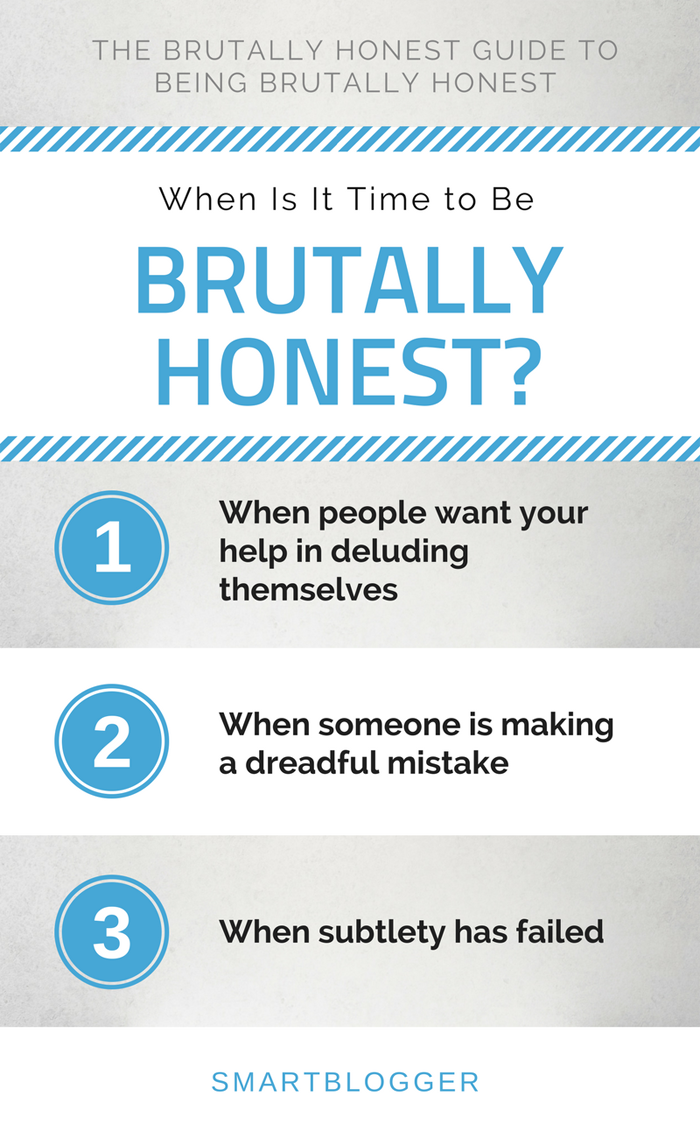
These aren’t the only circumstances which call for brutal honesty, but they are frequent ones, and they have two basic principles in common: the hearer badly needs to be told the truth, and yet it is very difficult for them to discover or receive it.
And that’s where you come in.
8 Steps to Being Brutally Honest Without Crushing Anyone’s Spirit
Great. So you understand what brutal honesty is, and what it is not. You know why brutal honesty is sometimes necessary, and when it is appropriate.
Now comes the hard part: How do you actually do it?
Here is an eight-step process to help you deliver that hard truth.
#1. Be Brutally Honest with Yourself
Brutal honesty begins with yourself. If you’re hesitant and tend to shy away from bluntly honest conversations, then the first step is to acknowledge why you hesitate.
Are you afraid of offending people? Ask yourself whether allowing them to continue on a harmful path is kinder than having an uncomfortable conversation with them.
Are you afraid that people will get mad at you, and perhaps cut ties with you? Do you worry about losing readers, subscribers, or clients?
As I mentioned above, ask yourself whether they’re better off not knowing, or whether you just don’t want to be the one to tell them.
Remind yourself that this is about doing what is best for them, not what is easiest on you.
#2. Check Your Motives
In the first step, you checked your motives for not wanting to be brutally honest with someone. In this step, flip that around—ask yourself if being honest with them is really about their well-being, or if it’s about you.
Yeah, that happens, too.
If it’s more about your desire to speak your mind than about what they need to hear, you’re likely to end up falling into that trap of being more brutal than honest.
So ask yourself this classic trio of questions about your message:
- Is it true?
- Is it necessary?
- Is it kind (or helpful)?
If the answer to all three isn’t yes, it’s time to reevaluate.
#3. Be More Honest than Brutal
Remember, the point is always honesty, not brutality.
You can tell the brutal truth without being brutal yourself. Let the truth be merciless on its own. It is hard enough for many to hear and face. So don’t add to it. Be kind.
Let me say that again: Tell them the whole truth, no matter how brutal it may be, but do it with kindness and empathy.
#4. Prepare Them for What’s Coming
Don’t just launch straight into the tough love. Give them the opportunity to prepare themselves for it.
Explain that you care about them. Explain that you have to tell them something you believe they need to hear, and prepare them for the degree of honesty they’re about to get from you.
For an example, look no further than what I did in the intro to this post:
It doesn’t take much. Just a heads-up about what’s coming, so that your audience can put themselves in the right frame of mind for it. Blindsiding them won’t make them more receptive to hearing a brutal truth.
#5. Reveal Your Intentions
Why are you telling them this difficult truth? What do you want to come of it? How is hearing it worthwhile to them?
Understanding what they have to gain from it will make the other person much more receptive to the harsh truth. It will be much easier for them to hear and accept if they genuinely believe that you’re trying to help them.
So take a moment to tell them why you think what you’re about to tell them is the best thing for them.
Again, you can see how I did that in this post. Before I hit you with the brutal truth, I first told you how I thought it would benefit you:
And then, with the benefit still fresh in your mind, I took off the gloves and told you the blunt truth.
#6. Be Short and Sweet
It’s never a good idea to beat a dead horse. As a writer, it’s a great way to get people to stop reading.
But this is even more true when your reader is taking a beating, too. Being told a hard truth is never fun. Sometimes it’s necessary. But having it thrown in your face over and over is something few people react well to.
So get to the point. Make it clearly and succinctly, and move on.
Anything more, and you’re heading back toward being more brutal than honest.
If you can’t be brutally honest with people, especially when you know it’s in their best interest, you’re a coward.
Notice how I don’t dwell on the cowardice for too long? Instead, I quickly move on to explaining the reasons behind my remarks.
#7. Stick to the Facts
This is easier for some topics than it is for others. Sometimes the facts are clear, measurable, and objective. You’ve got actual data, research — cold, hard facts. Other times, the issue at hand is a subjective assessment.
But even when the subject matter is wholly subjective, you can keep the discussion focused on the relevant issues.
Be as objective as you can, given the subject matter. Avoid emotional observations. Focus on actions — things the other person has done, or things they need to do — rather than on character and personality.
Most of all, focus on problems that can be solved.
Again, you can see that in my approach to this post. I didn’t dwell on negatives or beat you over the head with character flaws. As you can see below, I focused on the facts — which, in this case, meant explaining why I had just called you a coward by emphasizing things I knew you’d agree with:
You may convince yourself it’s “nicer” to hide or obfuscate things that are difficult for them to hear, but it’s not.
Ignorance doesn’t lead to bliss, it leads to bad decision-making. There’s nothing “nice” about that.”
#8. Conclude with a Solution
Don’t leave them feeling bad because of the truth bomb you just dropped on them. Help them figure out a solution. Give them a way forward.
Most of all, tell them how you’re going to help them, and commit to helping them tackle the issue.
How you end the discussion can make all the difference.
Do you want them to feel defeated, beat down, and discouraged? Or do you want them to feel hopeful that there are concrete ways that they can address the issue?
Imagine if I ended this post after calling you a coward, without offering any advice on how to deliver brutal truths. That would make the overall message feel far less benevolent and far more antagonistic, wouldn’t it?
Have the Courage to Tell the Unvarnished Truth and You’ll Win People’s Respect
Telling someone a hard truth can be scary.
Because you don’t know how people will react.
And I won’t lie. Some people won’t like it. Even if you take all the right steps, you may still offend them, and you may still lose them.
But you’ll also gain others who recognize the value of someone they can trust to be honest — the type of people who may never have paid attention to you while you were busy telling everyone what they wanted to hear.
And as you develop a reputation as a person who tells it straight, you will gain people’s respect. You will gain credibility and authority. People will seek out your advice, value your perspective, and appreciate your honesty.
And you will help people—far more than when you were telling them whatever they wanted to hear.
And isn’t that the point?
source https://smartblogger.com/brutally-honest/














 One of the “craziest” opportunities I had happened about a year after starting the blog when I was invited to speak in New Zealand.
 The coolest opportunity that arose for me as a beginning blogger was being asked to interview Thrillionaire celebrity Nik Halik. I had no clue
  In my early days of blogging, Air New Zealand flew me to the Cook Islands for a 24-hour event.
 The craziest opportunity that arose from blogging was that I ended up co-authoring a book with Guy Kawasaki and other A-listers when I was an unknown. Here’s how it happened:
 Blogging quite literally changed my life. Within months of starting my ecommerce blog,
  Within six months of launching the blog it was voted one of the top ten social media blogs in the world by a competition run by Social Media Examiner.
 In 2006, when I had been blogging only a few years and blogs were still somewhat of a novelty, I was contacted by a writer from TIME Magazine. She had found my blog and wanted to interview me for a story she was writing about one of my
  You never know who is reading or following your content. I found out that my all time favorite writer, and multi-NYT Bestseller, Ted Dekker, had come across my work.
 Very early on I had the opportunity to be featured on some pretty big sites as a guest poster, which wouldn’t have been possible if I hadn’t had the EOFire blog up and running. One of the first was on Think Traffic (now Fizzle.co), and we were featured there within just one month of having started our own blog.
 Back in March 2014, I had just started blogging. Basically, it was me, my mom, and literally 261 unique visitors (I checked with Google Analytics just to be accurate).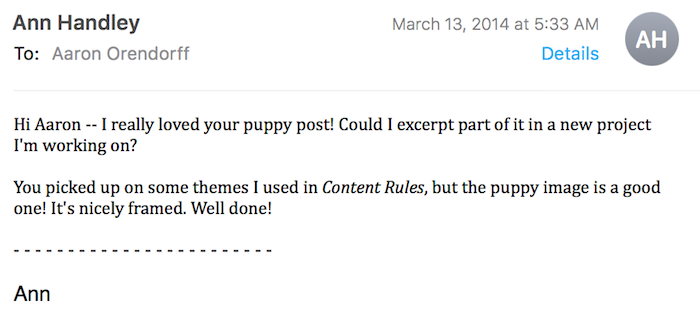
 About six months after starting my blog, I wrote a post about
  Back when I got started, I had NO clue what I was doing.
 When you are just getting started, you don’t really expect anything crazy to happen. But sometimes you get a big surprise!
 Blogging is a great way to showcase your expertise and expand your network. I learned this when, back in 2009, I landed a consulting gig with an agency of the United States Government! The guys from Voice of America (the official external US broadcaster) were planning to launch a new site, and they wanted to learn what would be the best ways to optimize and promote it. It was a very interesting experience, and certainly a nice touch to my CV!
 One of the craziest opportunities I received when I started out was not only having my guest post accepted at Marketing Profs but also getting an invitation to record a mini video training for their paid members.
 Well I got the opportunity to join my current startup, Ninja Outreach! The opportunity arose when I was invited on a podcast with my now partner Mark, who read my blog, only a few months after I started it.
 I can’t put this down to any one situation! Ever since we started the Foundr blog this has given us opportunities to interview some of the greatest entrepreneurs of our generation (Richard Branson, Arianna Huffington, Seth Godin etc.) and with this we’ve also been able to connect with some amazing entrepreneurs in our community which has been an extremely rewarding experience.
 The craziest opportunity that arose from blogging was being invited to speak at my first live class. I had been blogging for about six months when I was contacted by the Hawaii Chapter of a national women’s entrepreneur association, “Femfessionals” to speak at their Hawaiian Chapter dinner. They had found my name through another local business I had worked with in the past and found their way to my blog. I had just posted about “Charging What You’re Worth” and they loved the post so much they asked me to present on the same topic live, in front of their whole local chapter.
 When I first started blogging I came across a new internet marketing method with Shopify. I ended up writing about it on my blog and uploading a Video to Youtube. To my surprise this became a great opportunity and the opportunity grew my blog from around 1,000 visits a month to over 25,000.
 When you put yourself out there in any industry and start to gain a following and audience, new opportunities are going to come up all the time. I’ve learned to not get excited by any of them, as only a very small percentage will actually come together. However, when they do, it’s pretty cool!
 I would have to say that the craziest opportunity to come from blogging as I was getting started was the opportunity to be interviewed by a journalist from a nationally distributed magazine.
 The craziest thing that happened to me as I first got into blogging was in 2008, after blogging for just a few months, I connected with another blogger who had been doing it for years for the organization he ran. We started emailing back and forth, and once, when he was going to be traveling in my city, we met and he introduced me to his daughter.
 There are a lot of crazy opportunities that have happened thanks to blogging.
 I got to work with Tim Ferriss, Neil Patel, Lewis Howes and dozens of other entrepreneurs right after I started blogging.
 The craziest opportunity that came from blogging was the chance to
  My first ever client was Visit Jordan for a video campaign where I got to produce a series of videos in the capital, Amman.